
ADU types explained
Types of ADUs in California
California law recognizes a few different shapes an ADU can take: a separate backyard cottage, an addition on the house, a conversion of space you already have, and a junior ADU carved out of the house itself. Each one comes with its own state ground rules. Here's what each type is and what the state says about it.
Last reviewed October 18, 2026
Rules that apply to every type
- Permits are ministerial: no hearing or discretionary review. The agency has 15 business days to say whether an application is complete and 60 days to approve or deny a complete one (Gov. Code 66317, 66335).
- Fire sprinklers can't be required in an ADU or JADU if they aren't required for the primary residence, and building one can't trigger sprinklers in the main home (66314(d)(12), 66323(d)).
- Rentals of units permitted under 66323, and of every JADU, must be for terms longer than 30 days (66323(e), 66333(g)).
- Cities can't require the owner to live on site for an ADU (66315). JADUs are the exception, covered below.
- Under the state's 66323 path, a single-family lot can combine one converted ADU, one new detached ADU of up to 800 sq ft, and one JADU. A multifamily lot can combine conversions of non-livable space with detached ADUs. A city must also allow at least one ADU under its regular local standards (66314).
Sources: Cal. Gov. Code §66313 · Cal. Gov. Code §66314 · Cal. Gov. Code §66321 · Cal. Gov. Code §66322 · Cal. Gov. Code §66323 · Cal. Gov. Code §66333 · HCD ADU Handbook (March 2026 update, PDF) · HCD ADU ordinance review letters
Type 1
Detached ADU
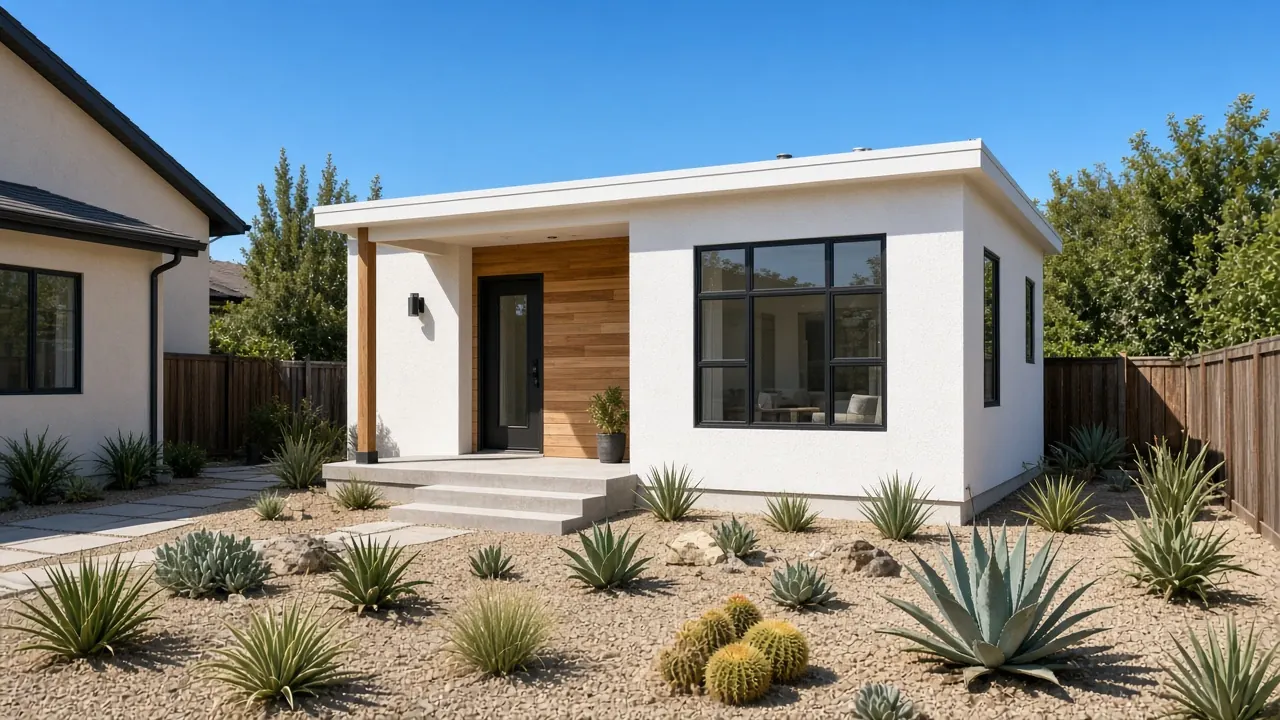
A brand-new, separate small home on the same lot, usually in the backyard. It has its own kitchen, bathroom, and entry, and doesn't touch the main house (it may connect to a garage or other accessory structure).
California state rules
- Definition
- A newly built unit on a lot with a proposed or existing single-family or multifamily home, detached from the primary dwelling (66313(a), 66314(d)(3); HCD Handbook, Types of ADUs).
- Size
- Up to 1,200 sq ft under the general rules (66314(d)(5)). A city may set a lower maximum, but not below 850 sq ft, or 1,000 sq ft for more than one bedroom (66321(b)(2)). Lot coverage, floor area ratio, open space and front setback rules can't block an 800 sq ft unit with 4 ft side and rear setbacks (66321(b)(3)). Under the 66323 path, the city may cap the unit at 800 sq ft.
- Height
- A city must allow at least 16 ft. It must allow 18 ft within a half mile walking distance of a major transit stop or high-quality transit corridor, plus 2 more ft (20 ft) to match the main home's roof pitch. It must allow 18 ft on a lot with a multistory multifamily building (66321(b)(4)(A)-(C)).
- Setbacks
- No more than 4 ft from side and rear lot lines (66314(d)(7)). An 800 sq ft unit with 4 ft side and rear setbacks can't be blocked by front setback rules; HCD notes such a unit may sit in the front setback (66321(b)(3); HCD Handbook).
- Parking
- At most one space per unit or per bedroom, whichever is less, and it can be tandem on a driveway (66314(d)(10)). None at all if the unit is within a half mile walking distance of public transit, in a historic district, near a car-share vehicle, or in other listed cases (66322(a)). A city can't require parking for a 66323 unit (HCD Handbook).
- How many
- On a single-family lot, one detached new-construction ADU under 66323(a)(2), which can be combined with a converted ADU and a JADU. On a multifamily lot, up to 2 detached ADUs if the multifamily building is proposed, or up to 8 if it exists, but never more than the number of existing units (66323(a)(4)).
Sources: Cal. Gov. Code §66314 · Cal. Gov. Code §66321 · Cal. Gov. Code §66322 · Cal. Gov. Code §66323 · HCD ADU Handbook (March 2026 update, PDF) · Riverside Municipal Code §19.442.030 · Los Angeles ADU Ordinance No. 186,481 (LAMC 12.22 A.33, PDF) · San Diego Information Bulletin 400 (ADU/JADU)
Type 2
Attached ADU
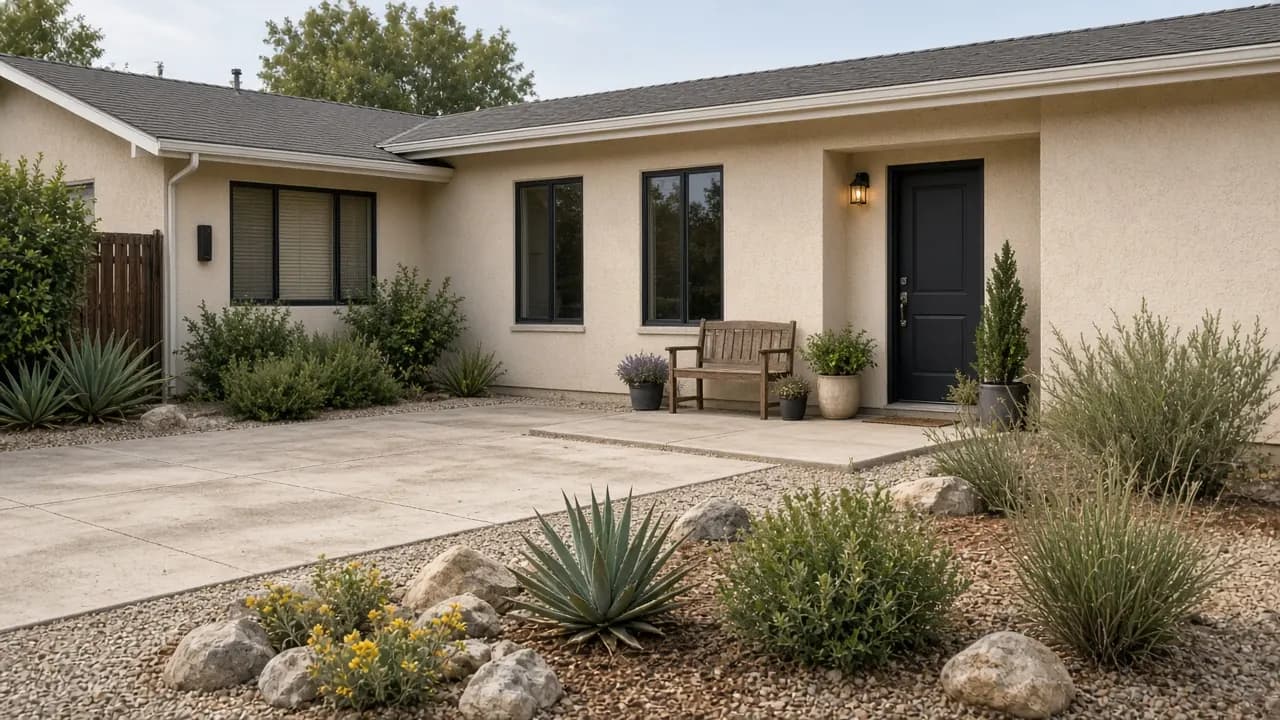
A new addition built onto the main house (to the side, rear, on top, or below) with its own entrance. It shares a wall, floor, or ceiling with the home but is a complete separate unit.
California state rules
- Definition
- A newly built unit that structurally connects to the existing or proposed primary dwelling and extends beyond its building footprint. Examples include an addition to a duplex, a unit over an attached garage, or a new second story (66314(d)(3); HCD Handbook, Types of ADUs).
- Size
- No more than 50% of the existing primary dwelling's floor area (66314(d)(4)). The state's 50% rule has no separate 1,200 sq ft cap, though cities may set their own. Whatever the local limits, they can't block an 800 sq ft unit with 4 ft side and rear setbacks (66321(b)(3)). A city's own maximum can't be below 850 sq ft, or 1,000 sq ft for more than one bedroom (66321(b)(2); HCD Handbook).
- Height
- Up to 25 ft, or the height limit for the main home, whichever is lower; cities don't have to allow more than two stories (66321(b)(4)(D)).
- Setbacks
- No more than 4 ft from side and rear lot lines (66314(d)(7)).
- Parking
- Same cap as other ADUs: at most one space per unit or bedroom, with the 66322 exemptions (near transit, historic district, car share, and so on).
- How many
- An attached ADU is usually the one ADU allowed under the city's regular standards (66314). It can sit alongside units built under the 66323 path where they qualify.
Sources: Cal. Gov. Code §66314 · Cal. Gov. Code §66321 · Cal. Gov. Code §66322 · HCD ADU Handbook (March 2026 update, PDF) · HCD findings letter to Upland (July 8, 2025, PDF) · Riverside Municipal Code §19.442.030
Type 3
Garage or space conversion
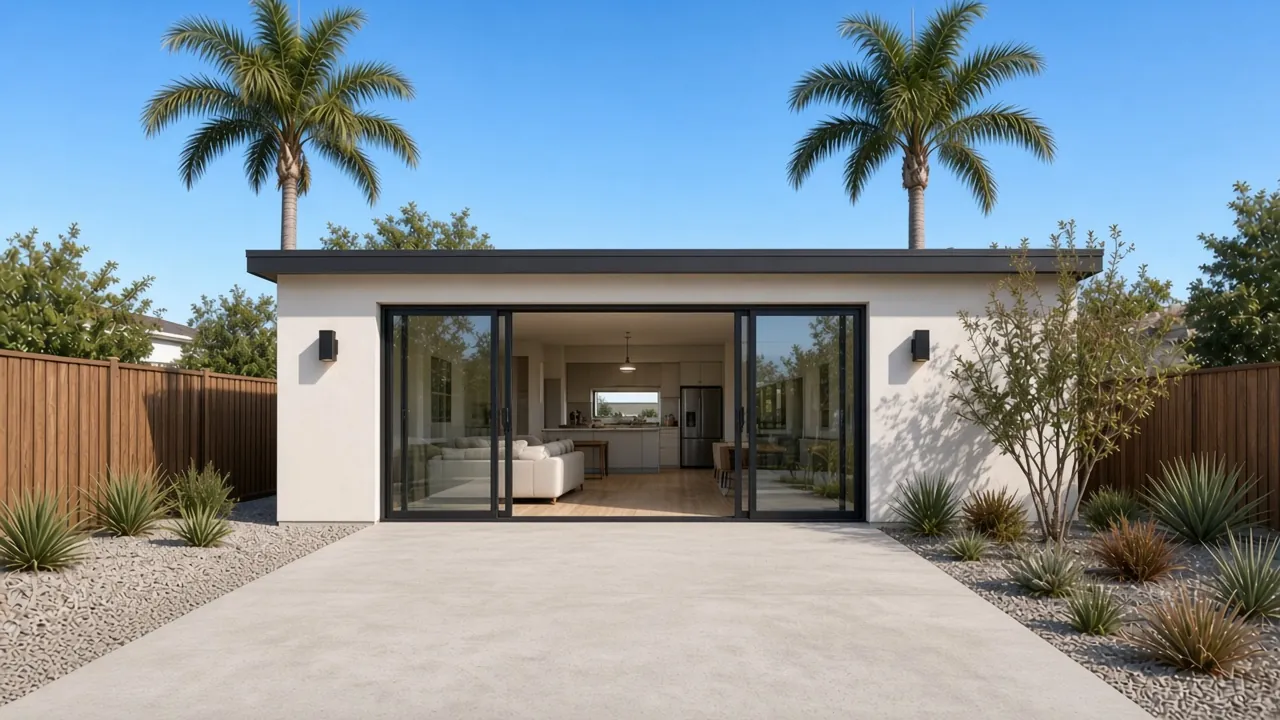
Turning space that already exists into a home: a garage, a workshop or shed, a basement, or part of the house itself. On apartment properties it can be storage rooms, attics, basements, or garages that aren't living space today.
California state rules
- Definition
- A unit created within the existing or proposed space of a single-family home, or the existing space of an accessory structure such as a detached garage. On multifamily lots, a unit created in parts of the building that aren't used as living space (66323(a)(1), (a)(3); HCD Handbook, converted ADUs).
- Size
- Converting existing space isn't subject to unit size limits (HCD Handbook). An ADU converted from an accessory structure may expand up to 150 sq ft beyond its existing footprint, only to make room for getting in and out, such as a stairway (66323(a)(1)(A)).
- Height
- Limited to the size of the existing structure being converted (HCD Handbook).
- Setbacks
- None required for existing living area or an existing accessory structure, or for one rebuilt in the same location and dimensions (66314(d)(7)). The 66323 path only requires exterior access and side and rear setbacks sufficient for fire and safety (66323(a)(1)(B)-(C)).
- Parking
- No parking can be required for an ADU that's part of the main home or an accessory structure (66322(a)(3)). If a garage, carport, or covered or uncovered parking space is converted or demolished for an ADU, the city can't make you replace those spaces (66314(d)(11)).
- How many
- On a single-family lot, one converted ADU plus one JADU, which can be combined with one new detached ADU (66323(a)(1)-(2)). On a multifamily lot, at least one ADU, and up to 25% of the existing unit count, in non-livable space (66323(a)(3)).
Sources: Cal. Gov. Code §66314 · Cal. Gov. Code §66322 · Cal. Gov. Code §66323 · HCD ADU Handbook (March 2026 update, PDF) · HCD findings letter to Moreno Valley (Dec. 9, 2024, PDF) · Riverside Municipal Code §19.442.030
Type 4
Junior ADU (JADU)
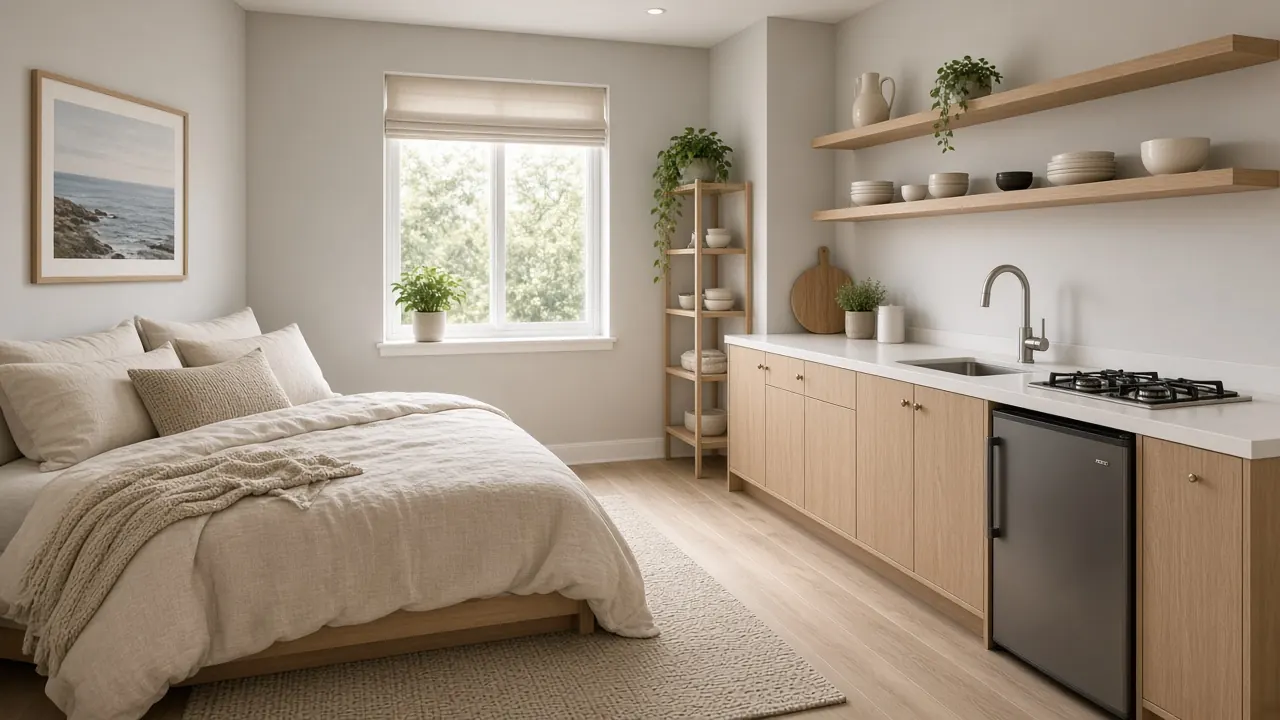
A small unit of up to 500 sq ft created inside a single-family home, often a bedroom suite or part of an attached garage. It needs a small "efficiency" kitchen and its own entrance, and it can have its own bathroom or share one with the house.
California state rules
- Definition
- A unit of no more than 500 sq ft of interior livable space, contained entirely within a single-family residence. It may have its own bathroom or share one (66313(d)). It must be built within the walls of the home; an attached garage counts as part of the home, but a detached accessory structure doesn't (66333(d); HCD Handbook).
- Size
- 500 sq ft maximum (66313(d)). The 150 sq ft expansion allowance for conversions doesn't apply to JADUs (HCD Handbook).
- Kitchen and entry
- Requires an efficiency kitchen: a cooking facility with appliances, plus a food prep counter and storage cabinets of reasonable size (66333(f)). Cities can't demand more, such as specific appliances or a 220V circuit (HCD Handbook). Requires a separate entrance; if there's no separate bathroom, it also needs an interior entry to the main living area (66333(e)).
- Owner occupancy
- Since January 1, 2026, owner occupancy can be required only if the JADU shares a bathroom with the house. The owner may live in either the JADU or the rest of the home. It can't be required if the JADU has its own bathroom, or if the owner is a government agency, land trust, or housing organization (66333(b), as amended by AB 1154). A deed restriction must bar selling the JADU separately and record its size limits (66333(c)).
- Height, setbacks, parking
- Because it's inside the existing home, the home's footprint and height apply. No additional parking can be required, even when it's made from an attached garage (66334(a); HCD Handbook). Fire sprinklers can't be required if the main home doesn't need them (66323(d)).
- How many
- One per lot zoned for single-family homes with a single-family home built or proposed (66333(a)). It can be combined with one converted ADU and one new detached ADU (66323(a)(1)-(2)). JADUs aren't available on duplex or multifamily lots (HCD Handbook).
Sources: Cal. Gov. Code §66313 · Cal. Gov. Code §66333 · Cal. Gov. Code §66334 · Cal. Gov. Code §66323 · HCD ADU Handbook (March 2026 update, PDF) · HCD findings letter to Sacramento (Jan. 20, 2026, PDF) · Riverside Municipal Code §19.442.030 · Long Beach: Accessory Dwelling Units · San Diego Municipal Code §141.0302
On apartment and duplex lots
- ADUs inside the building: at least one, and up to 25% of the existing units, in spaces not used as living space, such as storage rooms, boiler rooms, passageways, attics, basements or garages (66323(a)(3)).
- Detached ADUs: up to 2 on a lot with a proposed multifamily building; up to 8 on a lot with an existing one, but not more than the number of existing units. They need 4 ft side and rear setbacks and the 16/18/20 ft height floors. A city can't make you fix an existing building's setbacks of under 4 ft (66323(a)(4)).
- These can be combined. JADUs are only for single-family homes (66333(a); HCD Handbook).
How we checked this page
State figures were checked line by line against the current text of Gov. Code 66310-66342 on leginfo.legislature.ca.gov (including 2026 amendments from SB 543 and AB 1154) and against HCD's ADU Handbook, March 2026 update. Where a common shorthand differs from the statute, we followed the statute. For example, the state's attached-ADU limit is 50% of the existing home; it has no 1,200 sq ft attached cap.
For local differences we sampled public sources rather than surveying every city. We read HCD ordinance review letters for Upland (July 2025), Moreno Valley (December 2024) and Sacramento (January 2026), and Riverside's current municipal code §19.442.030. We also read Los Angeles' ADU ordinance (No. 186,481), San Diego's Information Bulletin 400 and municipal code §141.0302, and Long Beach's ADU page. We looked for Fontana, Temecula and San José material but did not find a well-sourced, current difference to cite, so they aren't named in the examples.
Local codes change, and some are out of date or under HCD review. A local rule that conflicts with state law may not be enforceable, but only your city or county, or a lawyer, can tell you how it applies to your lot.
Check ADU rules for your address